Comments from other authors and journalists
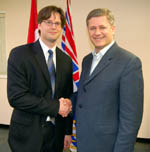
Jon with the Canadian Prime Minister Steven Harper
May 12, 2009
Ducking Bullets and braving check points By Jonathan D. Roth (Vancouver, B.C.)
The Iranian Revolution is best understood through the eyes of the men and women who experienced it. Brian Appleton’s new book, “Tales from the Zirzameen” is an intriguing tale that places the reader in the middle of Iran ’s most tumultuous period since the Kermit Roosevelt-planned coup of 1953. An American expat working for Bell Helicopter, Appleton had a thankless, yet fascinating job: he ensured the bodies of Bell workers who died while on assignment were transferred home efficiently; he was sent to douse cold water on drunken co-workers; and he welcomed new Bell employees sent to Iran from the U.S. A fixer extraordinaire, Appleton did his job well.
Appleton ’s social orbit was widely confined to the upper strata of Iranian society, which provides captivating reading for the well-informed Iran observer. Vividly illustrating the famously unlimited extents of Iranian hospitality, Appleton shares interesting anecdotes of life alongside famous movie directors, actors, and politicians.
Throughout the book it is obvious Appleton and his co-workers didn’t pick up on the underlying negative Iranian sentiments towards the Shah’s government - and by extension, the United States . As Appleton himself laments, he and his friends lived a plush, comfortable Western existence in the midst of a nation besieged by pent-up resentment.
The most appealing chapters of the book deal with the revolution itself. Taken hostage by revolutionaries, Appleton reveals the extraordinary courage of those who saved him. His sequential exposition and analysis of the days before, during, and after the coup are very informative and illuminating. Ducking bullets and braving checkpoints, Appleton exposes a world few have ever encountered.
Although “Tales from the Zirzameen” suffers through some structural and grammatical challenges, it is well worth buying. Few books do as good a job at spelling out the fear and uncertainty of those average individuals who suffered through Khomeini’s coup. Those interested in the current political relationship between the current Iranian regime and The West will find it to be an especially interesting historical document.
http://www.rothmultimedia.
com/about.php
 From Massoume Price From Massoume Price
Brian Appleton's reconstruction of life in pre-revolutionary Iran brings to life in a vivid and poignant manner the way life was in Iran at the time. His fluid and convincing prose takes the reader into the life of the affluent and modern Iranians he was acquainted with. What makes his account more interesting is the description of some very unusual experiences he himself went through while living in Iran. Dealing with corpses and mischievous and spaced out foreigners and acting in a movie along with some well known artists are not every day experiences many people will have while living abroad. His writing is both descriptive and emotional. For those of us who witnessed the life he is describing, reading the book becomes a nostalgic experience. For others with some or maybe no familiarity with life in Iran at the time, the book offers a good, sincere and fun reading. I knew some of the people he is talking about and was thrilled to look back and remember not just our youth, but also the splendid land so many of us were forced to leave behind.
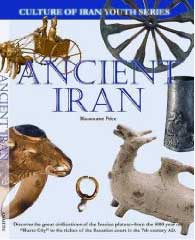
Ancient Iran (Culture of Iran Youth Series)
September 1, 2008
From Patrick Hunt
Dear Brian,
Great to hear from you. I know both Prof. Abbas Milani and Mohammad Hekmat. I also think Stanford is seeking to build up its Persian Studies program for undergraduates as well.
Dialogue is always important, including at present between states, because the West desperately needs to build bridges, not raise hackles in a world where the West has historically refused to give due credit to Near Eastern mathematicians, chemists, astronomers and other scientists and artists from whom much was borrowed without attribution from at least the 10th century CE onward, not to mention so many ancient borrowings you note. Of course this cultural and historical myopia continues to create added bitterness in the present Middle East. Alexander’s Greeks brought far more back than mere Orientalism to the West. They also brought about the Hellenistic world where Eastern influence shattered the myth of Greek cultural superiority in isolation. In far more than a diaspora of modern Iranians who have greatly blessed the US, the molten gold that ran through the streets of Persepolis after Alexander’s burning continues to flow today.
http://www.patrickhunt.net/
arch/arch.html
Patrick Hunt
Director, Stanford Alpine Archaeology Project, 1994–2008
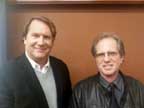 Patrick Hunt received a PhD from the Institute of Archaeology, University College London, University of London. His articles have appeared widely, in publications including the Journal of Roman Archaeology XI, World Archaeology, Studia Phoenicia, and Bulletin of the Institute of Classical Studies. He is the author of several books including Caravaggio (2004), House of the Muse (2005), Alpine Archaeology (2007), Ten Discoveries That Rewrote History (2007), and Renaissance Visions: Myth and Art (2008). Patrick Hunt received a PhD from the Institute of Archaeology, University College London, University of London. His articles have appeared widely, in publications including the Journal of Roman Archaeology XI, World Archaeology, Studia Phoenicia, and Bulletin of the Institute of Classical Studies. He is the author of several books including Caravaggio (2004), House of the Muse (2005), Alpine Archaeology (2007), Ten Discoveries That Rewrote History (2007), and Renaissance Visions: Myth and Art (2008).

Salaam Mr. Appleton,
Haal-e shomaa chetor hast?
September 1, 2008 I read about you last year when I saw Tales from the Zirzameen ads on Iranian websites
It’s nice to e-meet you.
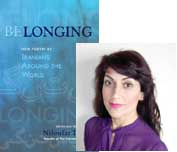
Thank you for connecting and for creating a generous blog entry about The Translation Project. My book, BELONGING: New Poetry by Iranians Around the World, came out two weeks ago (after 6 years of work!). That makes me a first time author, which is very exciting, as you know. I wonder whether you would be interested in including a link to my book in your existing entry as well. It would be lovely for your many enthusiastic readers to be able to access BELONGING. If you are interested, here is the amazon link and a thumbnail of the book.
http://www.amazon.com/ exec/ obidos/ASIN/ 1556437129/netnative
 Ghorbaaneh shomaa,
Niloufar Talebi
September 1, 2008
Dear Brian,
So happy you had a good time in Iran. I would like to see your photos. Your Five Days in Iran article is a very good report. See you soon.
Shahrnush
www.shahrnushparsipur.com
/index.htm
May 10, 2008
In response to Brian's speech at MIT, Noam Chomsky said:
A ver y moving and humane statement. Thanks for making it. I hope people will listen and learn. y moving and humane statement. Thanks for making it. I hope people will listen and learn.
Noam Chomsky
May 10, 2008
Fereydoun Safizadeh
Anthropology
Boston University
Dear Brian,
Thank you for all the trouble that you and Jahangir took to come all the way from California and bring this important film. I had been hearing for months about it. I also have appreciated your writings on Iran and Iranian people and culture. I would not be discouraged by the low attendance. Films, like books, like children have been brought to this world and have their own way of making their mark. This film leaves its mark beyond the tragic story of thousands of people who died including Tobb. A part of the mark is making people question why we think and react to Iran the way we do. Once this question is raised many people are likely to stop and think how they are led to think that way. And that is the beginning of not thinking that way, and that is where the humanizing objective that Jahangir and the film are striving for begins to take place.
It was a pleasure for me to meet you and Jahangir, to meet another anthropologist, and by the way when you mentioned Lowell House, I should mention that I was a resident of Adams House many years later than your father. I certainly will be promoting the film.
All the best,
Fereydoun Safizadeh
Meghan Nuttall Sayres, author of Anahita’s Woven Riddle, a novel set in 19th century Iran, and Weaving Tapestry in Rural Ireland, wrote:
Brian Appleton’s work is reflective of his open-hearted approach to Iranian culture and people in general. The many years he lived in Iran crystallized his ability to di scern social issues and appreciate the essential beauty and talent of Persian art and artists. scern social issues and appreciate the essential beauty and talent of Persian art and artists.
Website
 Fatemeh Keshavarz, author of: Jasmine and Stars, Reading more than Lolita in Tehran Fatemeh Keshavarz, author of: Jasmine and Stars, Reading more than Lolita in Tehran
Thanks Brian, it looks good.
Best, Fatemeh
Website
June 18, 2005
Azadeh Moaveni, author of Lipstick Jihad, wrote:
Dear Brian,
Thank you so very much for this thoughtful and engaged letter much appreciated your getting in touch, and your enthusiasm about my book. I am currently working on the Iranian election, and thus you can imagine quite overwhelmed by work. I did want to say salam though and merci for the lovely note.
Bests, Azadeh
Website
Sept 16, 2004
Michael Parenti, author of Terrorism Trap, wrote:
Thank you for your comments, Brian, you are right on target. Glad you found my book to be of value t o you. If you want further information take a look at my website: www.michaelparenti.org o you. If you want further information take a look at my website: www.michaelparenti.org
All the best, Michael
Website
Sept 16, 2004
Michael Parenti, author of Superpatriotism, wrote:
(In response to my sharing a right wing Iranian American hawk’s comments with him.)
My gosh, this is a classic case, I wish I had seen this letter when I was writing the book that just came out, called ‘Superpatriotism’ This individual has a serious case of it.
Dario Castagno: Film Maker and author of: Too Much Tuscan Sun, A Day in Tuscany and Too Much Tuscan Wine
To: Brian Appleton
From: Dario Castagno
Subject: Re by the way
Yep...I meant here in Chianti…
From: Brian Appleton To: Dario Castagno
Subject: by the way
In your trailer you mentioned that Etruscans may have started wine making 3 thousand years ago...actually I have done some research for my second book and it seems the Assyrians were making it 6,000 years ago. The special stone crushing basins with the built in slope and drain at one end have been found there dating that old.
Website
From Fatema Soudavar Farmanfarmaian:
To Brian Appleton
"Wow, I'm thrilled for you and for all of us Iranians too. You finally made it. Congratulations.
Finally, I went through all the blogs and comments and thoroughly enjoyed them. But please note that the first wine-making has been documented archeologically at Haji Firuz Tappeh in Iran at least 8000 years ago.There is no future for teatotalling in Iran.
Keep it up now that you have broken the ice,
Fatema SFF
April 21, 2005
Firoozeh Dumas, author of Funny in Farsi, wrote:
Dear Rasool,
I had 18 rejections (that’s right, 18) before I found an agent. And even though I am now a “published author”, I still get rejected left and right. I try to get speaking gigs and they tell me I’m not big enough. I try to get interviews and they tell me I have not sold enough books…it just goes on and on unless of course one is REALLY successful (like your friend Azar) and I’m guessing she has to put up with people bugging her for a million other reasons.
If you have a job where you are actually making money, ENJOY IT!!! And keep writing for the love of it. Every Iranian I know reads Iranian.com so you are being heard.
 Regards, Firoozeh Regards, Firoozeh
Website
Sept 15, 2004
Azar Nafisi, author of Reading Lolita in Tehran, wrote:
I am sorry, but I am still traveling and will be doing so for the foreseeable future. But of course I am curious and not just about what you write about me.
Best, Az
Website
Sunday, June 01, 2008 6:20 AM
To: George Monbiot
Subject: John Bolton
 Thank you for attempting to make a citizens arrest of John Bolton. I totally agree that the AEI has been running the show with no accountability to the American people. I think Mr. Bush will go down as the worst president in US history. I can’t believe how little protest there has been to his two wars and now he wants to attack Iran. Thank you for your courage. Please visit my website at www.zirzameen.com Thank you for attempting to make a citizens arrest of John Bolton. I totally agree that the AEI has been running the show with no accountability to the American people. I think Mr. Bush will go down as the worst president in US history. I can’t believe how little protest there has been to his two wars and now he wants to attack Iran. Thank you for your courage. Please visit my website at www.zirzameen.com
For a long time I couldn’t figure out what “Moonbat” meant, which I was referred to as by some skin head blogger called Guns and Guts. I now know and I am flattered to be compared to you.
Take care and God Bless,
Brian
Dear Brian,
Many thanks for your message and kind words of support,
All good wishes,
George
|